
Using the Latest/Greatest Tool
 If you are not innovating you are dying. There’s always some magical new tool coming down the pike and you’d better start using it or you’re going to get beat. The latest, of course, is AI. Here at VCI we’ve heard from companies that top management has told everyone, “If you use a computer, you will be replaced by AI.”
Scary words,
but emblematic of the zeitgeist that we are laboring under: if you’re not using AI, you will be replaced by it. The only mitigating factor is that we have seen all this before…many times.
Remember the cloud? I do, but it’s foggy. Before that it was nanotech. And it’s always been automation.
With every new technology we’ve had bosses railing at us to use it or lose our jobs. This has led to so many failures,
- Tesla’s Production Hell in 2018
- GM’s “lights out” factories in the ‘80s
- God walking on earth
In all of these cases the tool worked great in the lab or in the pilot plant, but when it was scaled to commercial production it turned into a nightmare. The reasons were all over the map, but always centered around the interaction between the new tool and the people who were using it.
A key point here is that I’m NOT talking about the training of the users. The problems stem from the fact that scaling up the volume of use invariably exposes a change in the fundamental character of the process. Unless that change in the character of the process is fully understood and built into the design, start-up will be disastrous.
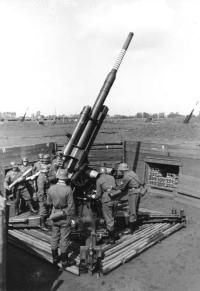
I’d like to illustrate this concept with a non-production example. It has to do with the US army during WW 2. My knowledge of the story began, however, in front of a TV set in the 1960s. My dad and I were watching a documentary on WW 2 cannons. It identified the German 88 mm as the best cannon in WW 2.
I looked at my dad and saw a disparaging look. This didn’t surprise me. My dad had a 30 year career in the army going back to WW 2, much of it in artillery. He was also an extreme patriot and wasn’t afraid to express it. I waited for the thunderstorm to break.
“American artillery was the best,” he muttered.
“Dad! You heard them say that the German 88 was the best cannon in WW 2. Were they wrong?”
“They weren’t wrong. The 88 was the best cannon.”
“Well, what about our cannons?”
“Our cannons were good enough.”
“How could we have been the best then?”
“We had the best artillery, not the best cannons. Our artillery was best because we had the best command and control and we used a concept called Mass Fire.”
He went on to explain that other nations’ artillery would either line its artillery up hub-to-hub in a long line firing straight ahead, controlled by a single HQ, or it would be distributed within individual units and controlled independently.
The disadvantage of the hub-to-hub approach is that individual infantry divisions could not be supported as they moved across the country. In addition, the inflexible command & control did not allow them to concentrate fire on an enemy attacking at a single point in the line.
The distributed approach (which the German army used) allowed flexible support to individual divisions. Again, though, there was no central control allowing fire from multiple divisions to be concentrated on a focused enemy attack at a single point in the line.
In the American army, artillery was distributed into individual units, but was controlled centrally, thus achieving the best of both worlds. Being assigned organically within individual infantry divisions allowed the organic artillery to provide close support to that infantry unit.
At the same time, the distributed artillery could be controlled centrally and all their fire could be massed on one target quickly. If a column of German tanks was attacking a single point in the line, all the artillery within range could be concentrated on that column.
“Particularly effective was the time on target (TOT) mission, whereby the fires across corps artillery and DivArty massed their guns on a single target—often 10 or more battalions—with all shells arriving nearly simultaneously on target. This was devastating, as Comparato writes, because “the TOT mission often denied to the enemy the bare 10-second’s time to jump into a foxhole—and often Allied troops were able to walk in ‘without a scratch.’”
Of course, the coordination of widely distributed artillery battalions required intensive training and robust communications.
“At the end of the war, Patton stated: “I do not have to tell you who won the war. You know our artillery did.””
Turning from WW 2 warfare to 21st century business, what does it mean for me trying to use AI? I only know three things:
- It’s not going to be a matter of turning it on and it either works or it doesn’t. I need to dedicate time to learn how to use it.
- Every use will be iterative. I have to define the question correctly, review the result, and ask follow-up questions as needed.
- I need to treat the AI like an intern. Every result has to be questioned, and I need to check the references.
How about you? Do you have a similar story? What has worked best for you? Comment below.

Add new comment